
The Web Has Split: Why Websites Must Be Built for Humans and AI
For years, building a website followed a predictable formula. Focus on design, improve speed, optimize structure, and drive traffic.
That model is no longer enough.
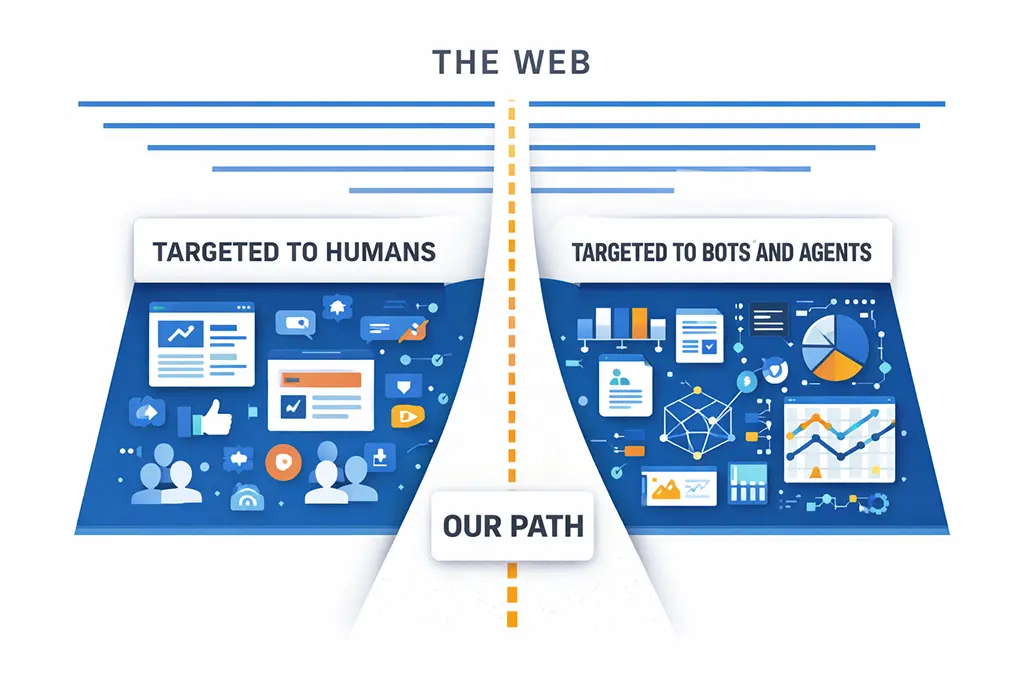
The modern web has shifted in a fundamental way. Today, high-performing websites need to serve two audiences at the same time: people and machines.
Two Layers of the Modern Web
Every website now exists in two layers.
The first is the human layer. This is what users see and interact with. It includes your design, messaging, navigation, and overall experience. This layer determines whether visitors trust your brand and take action.
The second is the machine layer. This is how your website is interpreted by search engines, AI platforms, and automated systems. These systems don’t view your site the way people do. They rely on structure, clarity, and data to understand what your business offers and when it should appear.
Both layers are essential. But most websites are built for only one.
What Are AI-Ready Websites?
AI-ready websites are built to perform across both human experience and machine interpretation. They combine custom layout design, structured data, and technical site architecture so users can engage naturally while search engines and AI systems understand and surface the content accurately.
Where Websites Fall Short
Many businesses invest heavily in design. Their websites look polished and professional, but lack the structure needed for search engines and AI to properly interpret them. As a result, visibility suffers.
Others focus strictly on technical structure. These sites may appear in search, but often struggle to convert visitors into leads or customers.
In both cases, there is a disconnect. The website works in one context but fails in the other. That gap leads to missed opportunities, wasted traffic, and inconsistent results.
Businesses that invest in AI-ready website design are better positioned to stay visible as search and AI-driven discovery continue to evolve.
Why This Shift Matters Now
AI is changing how people discover information.
Search engines are no longer just presenting links. They are summarizing results, recommending businesses, and filtering what users see. Increasingly, users are getting answers without ever browsing multiple websites.
This means your website needs to be structured in a way these systems can understand and trust.
At the same time, when someone does visit your site, it still needs to perform. Clarity, speed, and usability still determine whether that visit turns into a result.
Visibility and conversion are now tightly connected. You can’t rely on one without the other.
Incorporating these structural principles into your online strategy ensures your site remains clear to visitors while providing the underlying data search engines and AI discovery platforms rely on.
Websites as Integrated Systems
The most effective websites today are not built in pieces.
Design, content, site architecture, and performance are no longer separate tasks. They need to work together as a single system. A strong website communicates clearly to users while also providing the structure and signals that search engines and AI rely on.
When these elements are aligned, your website becomes more than a marketing asset. It becomes a foundation that supports growth across channels.
What It Means to Build for Both
Building websites for humans and AI is not about compromise. It is about alignment.
A well-built site guides users naturally, communicates value clearly, and makes it easy to take action. At the same time, it is structured in a way that allows search engines and AI systems to interpret and surface it accurately.
When both sides are considered from the start, performance improves across the board. Visibility increases, engagement improves, and conversions become more consistent.
The Advantage of Getting It Right
Websites that work across both layers benefit from compounding effects. They are easier to find, easier to understand, and more effective at turning attention into results.
Instead of relying on constant adjustments or short-term tactics, they provide a stable foundation for marketing. Traffic becomes more valuable, and growth becomes more predictable.
Final Thought
The web has not just become more competitive. It has become more layered.
Websites built only for people or only for search engines will continue to struggle. The ones that succeed are built for how the web actually works today.
That means building for both humans and AI.
Next Step
Whether you are updating an existing site or building a new digital platform, our Fort Collins web design team creates sites built for both human engagement and machine clarity.